 Blaine
 Why Cherry Point Decks Fail Sooner Than You'd Expect
Cherry Point sits right on the water along the Strait of Georgia, just outside Blaine in Whatcom County, and that shoreline location changes what a deck has to survive. Homes here take a steady dose of salt-laden air moving in off the strait, which accelerates corrosion on anything metal — nails, screws, joist hangers, railing hardware — long before the wood itself shows real damage. Add in Whatcom County's driving rain, which comes in sideways more often than straight down out here, and water finds its way into joints, fastener holes, and end grain that a calmer inland deck would never see.
Then there's moss season, which in this part of Washington runs a good chunk of the year. Shaded decks, or ones tucked under trees, stay damp for days at a time. Moss and algae hold moisture against the deck boards and framing, which is exactly the environment rot and fungal decay need to get started. A deck built without that combination in mind — standard fasteners, minimal ventilation under the boards, no real plan for drainage — will show its age years ahead of schedule.
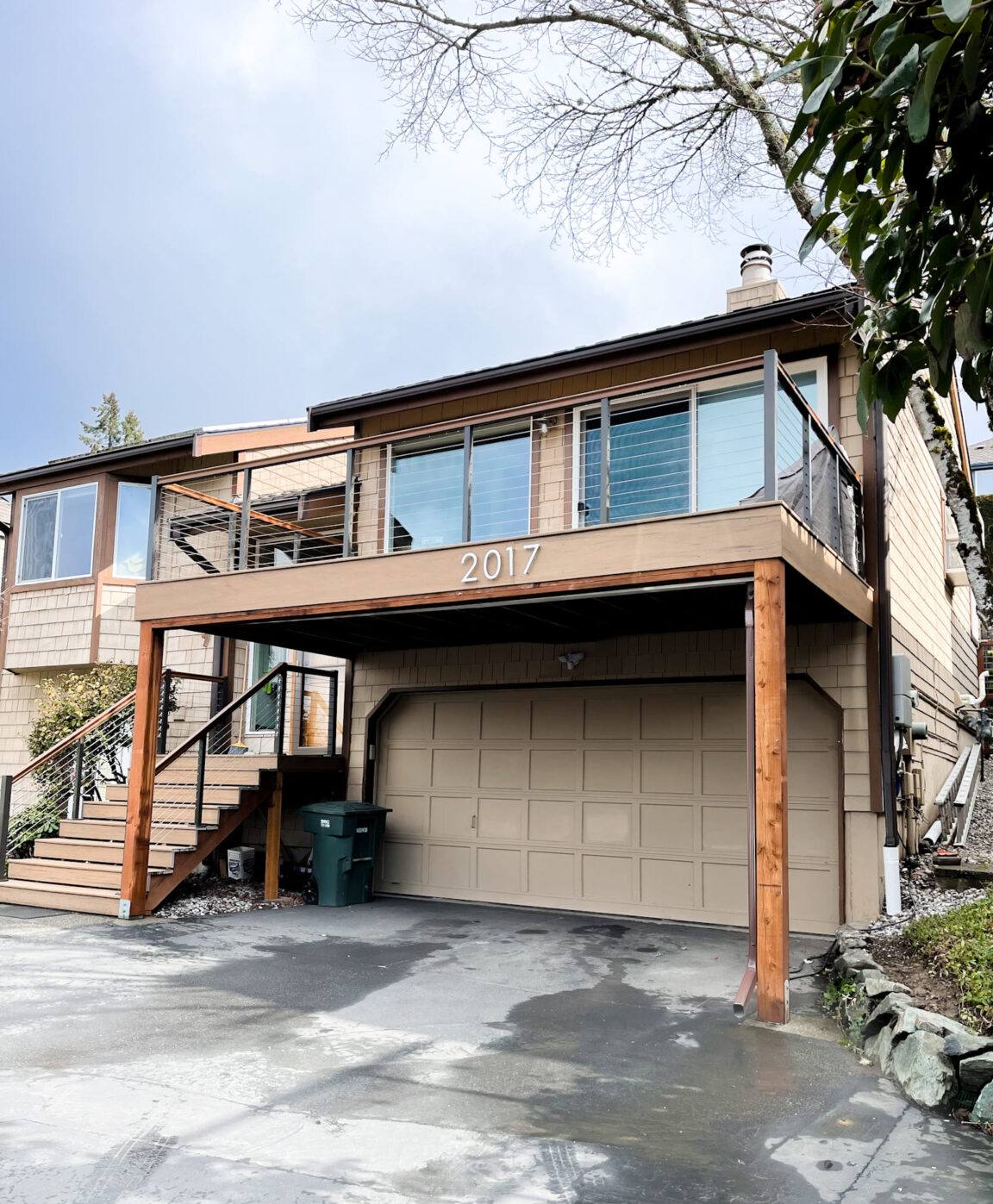
Repair or Replace? How to Tell
Not every tired-looking deck needs to come out. But there's a point where patching individual boards or hardware is just delaying a bigger job — and spending money that won't show up in the final result. A few signs that point toward full replacement rather than repair:
- Soft, spongy, or spring-y decking when you walk across it, especially near the house or along the perimeter
- Rust staining bleeding out from screw heads or hanger hardware across multiple boards
- Visible gaps or rot at the ledger board where the deck attaches to the house
- Persistent moss or dark staining that keeps coming back within weeks of cleaning
- Railing posts that flex or feel loose at the base
- Framing members (joists, beams, posts) that are cracked, split, or show fungal decay when probed with a screwdriver
- A deck more than 15-20 years old built to older code, especially around ledger attachment and footing depth
If the framing underneath is sound and it's really just the decking boards that have given out, a resurfacing job can make sense. But once the structure itself — ledger, joists, footings — is compromised, replacement is the honest answer. Rebuilding on a bad foundation just means doing the job twice.
What "Just the Boards" Can Hide
One thing we check carefully on Cherry Point deck evaluations: a deck can look fine on the walking surface while the framing underneath is already failing. Because moisture from driving rain tends to collect at the ledger connection and around post bases, those are exactly the spots hidden under decking boards where damage builds quietly. A proper inspection means pulling a few boards, not just walking the surface and eyeballing it.
What a Correct Deck Replacement Actually Involves
A deck replacement done right is a structural project first and a finish-material choice second. The order of priorities matters:
Ledger and Attachment
The ledger board — where the deck ties into the house — is the single most common failure point on older decks, and it's the connection that has to handle the most water intrusion. A correct replacement means proper flashing integrated with the house's water-resistive barrier, not just a bead of caulk, plus structural fasteners sized and spaced to current code.
Framing and Footings
Joists, beams, and posts get sized for the actual load and span, not just matched to whatever was there before. Footings need to sit below frost depth and bear on solid, undisturbed soil — something that varies more than people expect from lot to lot in this area depending on drainage and fill history.
Fasteners and Hardware
Given the salt air here, we don't treat hardware as an afterthought. Stainless steel or heavy hot-dip galvanized fasteners and connectors cost more up front but are the difference between hardware that lasts the life of the deck and hardware that's rusting and staining within a few seasons.
Drainage and Airflow
Decking gets installed with consistent gaps for drainage, and where the deck sits low to the ground or in a shaded spot, we look at ventilation underneath so moisture has somewhere to go instead of sitting against the framing.
Choosing a Decking Material for This Climate
There's no single "right" material for every Cherry Point property — it depends on sun exposure, how close the deck sits to the water, budget, and how much upkeep you want to sign up for. Here's how the common options actually compare in a salt-air, high-moisture environment:
| Material | Moisture / Salt Air Performance | Maintenance | Relative Cost |
|---|---|---|---|
| Pressure-treated wood | Good if properly sealed and re-sealed; end grain and fastener holes are vulnerable points | Annual cleaning and periodic re-staining/sealing | Lowest upfront |
| Cedar / other natural wood | Naturally moderate rot resistance, but still needs sealing near salt air | Regular sealing to hold color and resist moss | Moderate |
| Composite decking | Very good — doesn't absorb moisture or rot; some products can show mildew on the surface in shaded, damp spots | Occasional washing; no staining or sealing | Moderate to higher |
| PVC / capped polymer | Excellent moisture and salt-air resistance since it has no wood fiber to absorb water | Lowest — soap and water cleaning | Highest upfront |
We're generally cautious about lower-grade composite products that use uncapped wood fiber — in a wet, shaded climate like this one, they can hold moisture at the surface and grow mildew faster than a capped composite or PVC board will. That's a maintenance and appearance trade-off worth knowing before you buy, not a knock on composite decking as a category.
How We Handle a Cherry Point Deck Replacement
- On-site evaluation: We walk the existing deck, check the ledger, probe framing for hidden rot, and talk through what you actually use the space for.
- Honest scope and estimate: You get a clear breakdown of what's structural, what's material choice, and what's optional — no surprise change orders for things we could see up front.
- Permitting: Deck replacements typically require a permit through Whatcom County or the applicable local jurisdiction; we handle that paperwork as part of the job.
- Demo and structural rebuild: Old decking, framing, and footings that don't meet current standards come out and get rebuilt to code, with hardware chosen for this environment.
- Decking installation: Boards go down with proper spacing and fastening for your chosen material.
- Final walkthrough: We go over the finished deck with you, including what maintenance (if any) the material requires.
Why Local Experience on Cherry Point Actually Matters
A lot of deck problems out here aren't about bad workmanship in general — they're about a deck built to a generic spec that never accounted for this specific stretch of coastline. A crew that regularly works Cherry Point and the surrounding Blaine area already knows which fastener grades hold up against the salt air, which lots tend to have drainage quirks, and which orientations get hit hardest by driving rain off the strait. That's the difference between a deck that's guessing at durability and one that's built for the conditions it will actually face.
It also means faster, more accurate estimates. We're not learning the area's weather patterns and soil conditions on your job — we've already seen how decks in this specific location age, what fails first, and what actually holds up over time.
Keeping a New Deck in Good Shape
Once a replacement is done right, a little seasonal attention keeps it that way — especially through moss season:
- Sweep debris and standing leaves off the deck surface regularly, especially in fall
- Rinse off salt spray and grime a few times a year if the deck faces open water or wind
- Check fastener heads and hardware annually for early rust staining
- Keep gutters and downspouts clear so runoff isn't draining directly onto the deck
- Re-seal wood decking on the manufacturer's recommended schedule — don't wait until it looks dry and gray
- Trim back overhanging branches to cut down on shade-driven moss growth
Get an Honest Look at Your Deck
If your deck on Cherry Point is showing rust stains, soft spots, or persistent moss that won't quit, it's worth having someone take a real look at the framing before deciding between repair and replacement. We offer free, no-pressure estimates — fill out the form below and we'll take a look and give you a straight answer about what your deck actually needs.